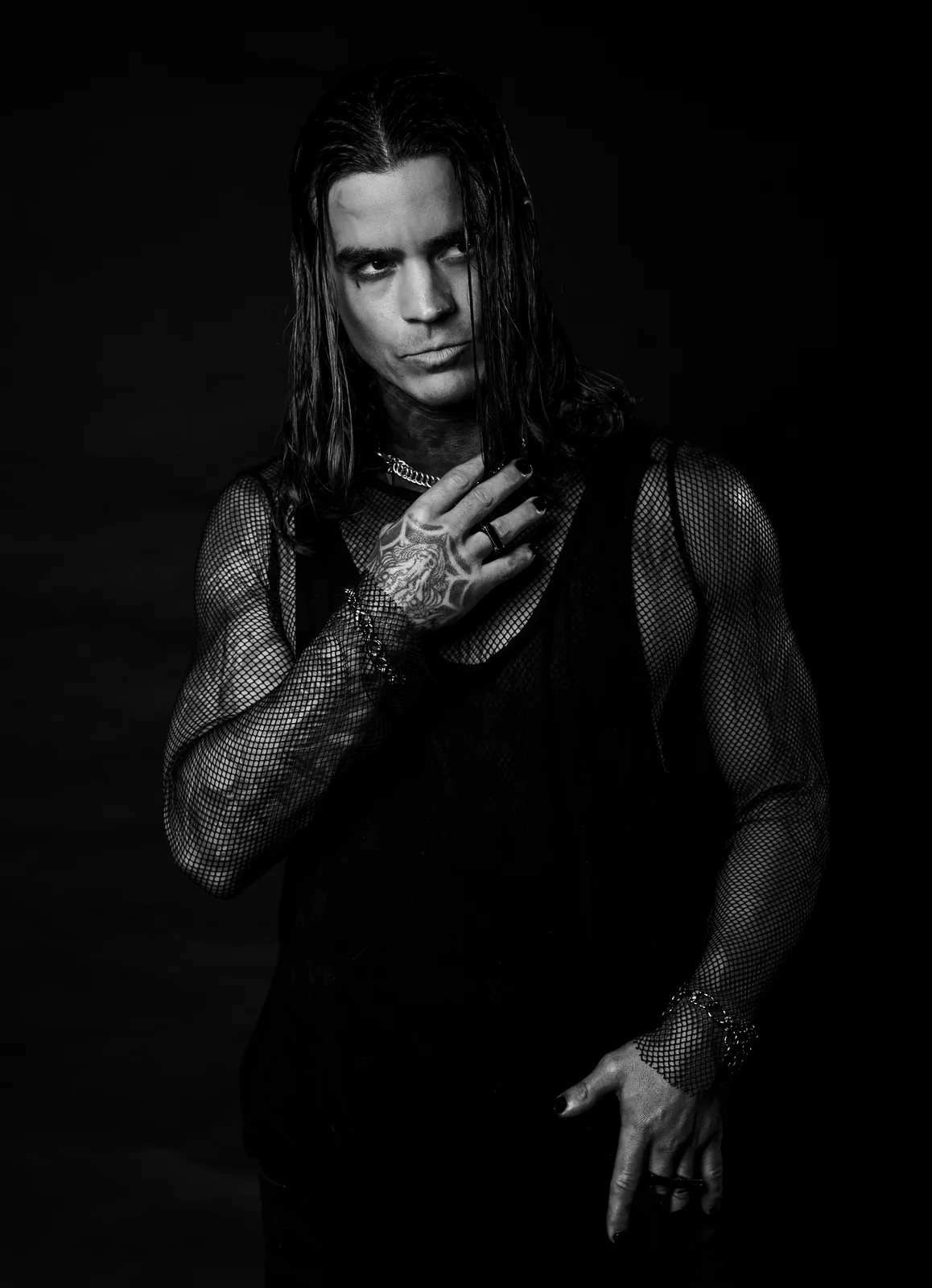
A Brief History of Daemon Grey
Daemon Grey’s love for metal started in elementary school. He remembers hearing his first heavy riffs and becoming completely obsessed. He would sit in his bedroom with a CD player, playing the same riff or breakdown on repeat for hours. The primal, raw, energetic feeling he got from heavy music was unlike anything else.
It felt like home, and honestly, nothing has changed since those early days.
Daemon started with classic metal, then quickly expanded into more extreme forms, black metal, thrash, melodic death metal, by the age of eleven. He started working on his scream shortly after. Metal became the most important force in his life. He loved the intricacies of the music, and the emotional intensity of screaming vocals especially fascinated him.
In high school, Daemon naturally gravitated toward friends who loved metal as much as he did. Dan and Dave Winter were brothers who played drums and guitar, just like Dime and Vinnie from Pantera, a band they all worshipped. Eventually, the three of them started Northern Steel, a band he still thinks was ahead of its time. They blended Pantera’s groove with elements of hardcore and thrash, pulling from Pantera, Metallica, Megadeth, Ozzy Osbourne, Black Sabbath, Sepultura, and Slayer. Dan and Dave gravitated toward classic metal, and Daemon loved that sound too. But he also brought in heavier influences, like death metal and hardcore. Northern Steel was an incredible time in his life. He was finally the frontman of a real metal band, writing lyrics and helping write the songs as a unit. They started out covering Metallica, Pantera, Ozzy Osbourne, Black Sabbath, and Slayer, before eventually writing originals he still loves to this day. The band started playing shows around the Southern Ontario metal scene and began making real noise.
It was my first taste of performing with a band on stage, and there was no feeling like it. Using lyrics and poetry to express energy, attitude, and power through heavy vocals and music, that was something truly special for me to discover.
As Northern Steel gained some notoriety, they entered a major battle of the bands, with the grand prize being free recording time at a high quality studio to record an EP. They won that show clearly, with fans lining up afterward to meet them. Daemon was completely dedicated to the band, ready to drop out of school to focus on it full time. But bands can be difficult to manage. Dan and Dave had other things going on in their personal lives, and the band eventually broke up.
I was devastated, but I’ll never regret a single moment of it. It was amazing.
Throughout university, Daemon kept looking for a band that could compare to Northern Steel, but nothing ever came close. He joined a few different bands and played shows as frontman, but always felt like something was missing. He was adopting other people’s songs rather than writing them or shaping their vision. While he loved performing live as a frontman, he missed the writing process, one of the parts he loved most.
After more than ten years of trying to make a band work, I knew instinctively that I needed to do this on my own.
That’s when Daemon started developing his own a cappella writing process, a technique that took years to hone. He created the vision and initial sound for Daemon Grey, along with a cappella demo tapes for two songs he had written, “Stoned and Alone” and “I Don’t Wanna Grow Up.” He had already spent time in multiple studios recording demos, and he knew he needed a world-class studio and producer to bring his vision to life. So he cold called and emailed the biggest music producers in Toronto, sending his demos without knowing what to expect. One day, he got an email back from an assistant of Gavin Brown, one of the most prominent rock producers in Canadian history: Gavin wanted to meet. Daemon was ecstatic. He met Gavin at Noble Street Studios, a grand, beautiful studio in Toronto’s west end. There, he performed his a cappella demos, screaming and singing four feet from Gavin’s face while Gavin simply sat and watched.
When I sang ‘Stoned and Alone,’ I noticed a small smile creep onto his face. At the end of the song, he looked at me and said, ‘That’s a hit.’
It was one of the happiest moments of his life, especially since Daemon had always believed the same thing about that song himself. Gavin then brought a few more people into the studio and asked him to perform again.
I puffed up my chest and went for it, his way, I think, of testing whether I was a real performer.
After that meeting, Gavin said he wanted to launch the project with him. It kicked off one of the most incredible periods of Daemon’s life: making his first album at Noble Street Studios with Gavin Brown. The two of them built an intimate, close relationship almost immediately. Writing music with someone is deeply personal, and Gavin was helping Daemon bring his biggest life passion to reality. Through working with him, Daemon also got to collaborate with people like Randy Staub, Mike Riley, Kevin “Thrasher” Guft, and Neil Sanderson. He had always known he could write songs, known he was a performer, known he had ability in heavy music.
Gavin was the first high level professional to truly validate that, not just as a frontman, lyricist, and vocalist, but as a true songwriter. That meant everything to me.
From there, Daemon formed a band to tour, playing shows around Ontario and a bit in Los Angeles. During Canada Music Week, an A&R representative from Out Of Line Music saw his live performance in person and was impressed by both the music and the Daemon Grey vibe. He was thrilled to join the Out Of Line Music family. The journey continued with his second album, “Daemonic,” made in Los Angeles with Mike Riley and his team. Afterward, Daemon refined his songwriting process even further, gaining a much deeper understanding of how he turns ideas into fully engineered, produced songs.
Next, he wrote and created the 17 EP in Toronto with Kyle Marchant. After that, Daemon took time to reflect on everything he had learned through production, live performance, and songwriting. Then he put everything he had into his third full length album. He obsessed over every lyric, melody, riff, and drum pattern, determined to make an album that captured the full Daemon Grey sound while carrying forward every lesson he’d learned over the past decade. It also carried every ounce of inspiration since he first fell in love with heavy music in grade five, at ten years old.
In total, it took Daemon three years to bring the third Daemon Grey LP to life, beginning with his mental a cappella songwriting stage. Then came a full summer recording and voicing every instrument. He built a complete a cappella version of the album front to back, every lyric, every vocal, every guitar, drum, and bass part. It became a fully composed metal album made entirely from his mind and his voice. After two months in the studio making the actual music, the third LP was finally done. And that brings us to now: the process of bringing his magnum opus, his greatest creation yet, out into the world.